
Native and adapted planting, turf reduction, hydrozoning, and drip conversion for Durango and the surrounding area. Done right, it is a landscape that still looks designed in August, in a drought year, under restrictions.
A conventional lawn in Southwest Colorado is a piece of imported climate. It needs four to five times the water the sky delivers, every summer, in a region where that water is contested and becoming more so.
Established native and adapted planting handles the drought conditions that brown a bluegrass lawn in two weeks. The property that looks best in a dry July is the one designed for the climate it actually lives in.
We are not against lawn. We are against watering grass nobody stands on.
01
Plan and Design First
Sun, wind, slope, drainage, and how you use the space set the layout. Plant selection comes after the plan, not before it.
02
Improve the Soil Selectively
Amendment where planting needs it, left alone where true xeric species would rot in enriched soil. Not a blanket treatment across the whole yard.
03
Limit Turf to Where It Earns Its Place
Keep grass in play areas, dog runs, and seating areas. Remove it from strips and slopes nobody walks on. Most properties have an obvious first candidate.
04
Choose Cold-Hardy, Adapted Plants
Zone 5b natives and proven xeric species. Cold-hardy first, drought-tolerant second -- that is the right order at this elevation.
05
Hydrozone
Plants grouped by water need so one valve does not drown a xeric bed to keep a thirsty border alive.
06
Mulch Well
Holds moisture and suppresses weeds. Material choice matters near a structure: noncombustible materials only.
07
Irrigate efficiently
Drip at the root instead of spray into Colorado wind. Often the biggest single efficiency gain available on a residential property.
08
Maintain it
Low-maintenance is not no-maintenance. Seasonal cutback, weed pressure, and irrigation checks keep it looking like a deliberate design.
━ The case
Statewide, outdoor irrigation accounts for a large share of residential water use. Along the Front Range, Colorado State University estimates it approaches 55% of household water consumption, most of it on turf. Water researchers have a term for the strips of grass nobody walks on: non-functional turf. Removing it is one of the least disruptive conservation moves available to a property owner.
The other half of the argument is resilience. When restrictions land in a dry July, a bluegrass lawn browns within a fortnight. Established native and adapted planting does not. The property that looks best in a drought year is the one designed for the climate it is actually in.
━ Before & after
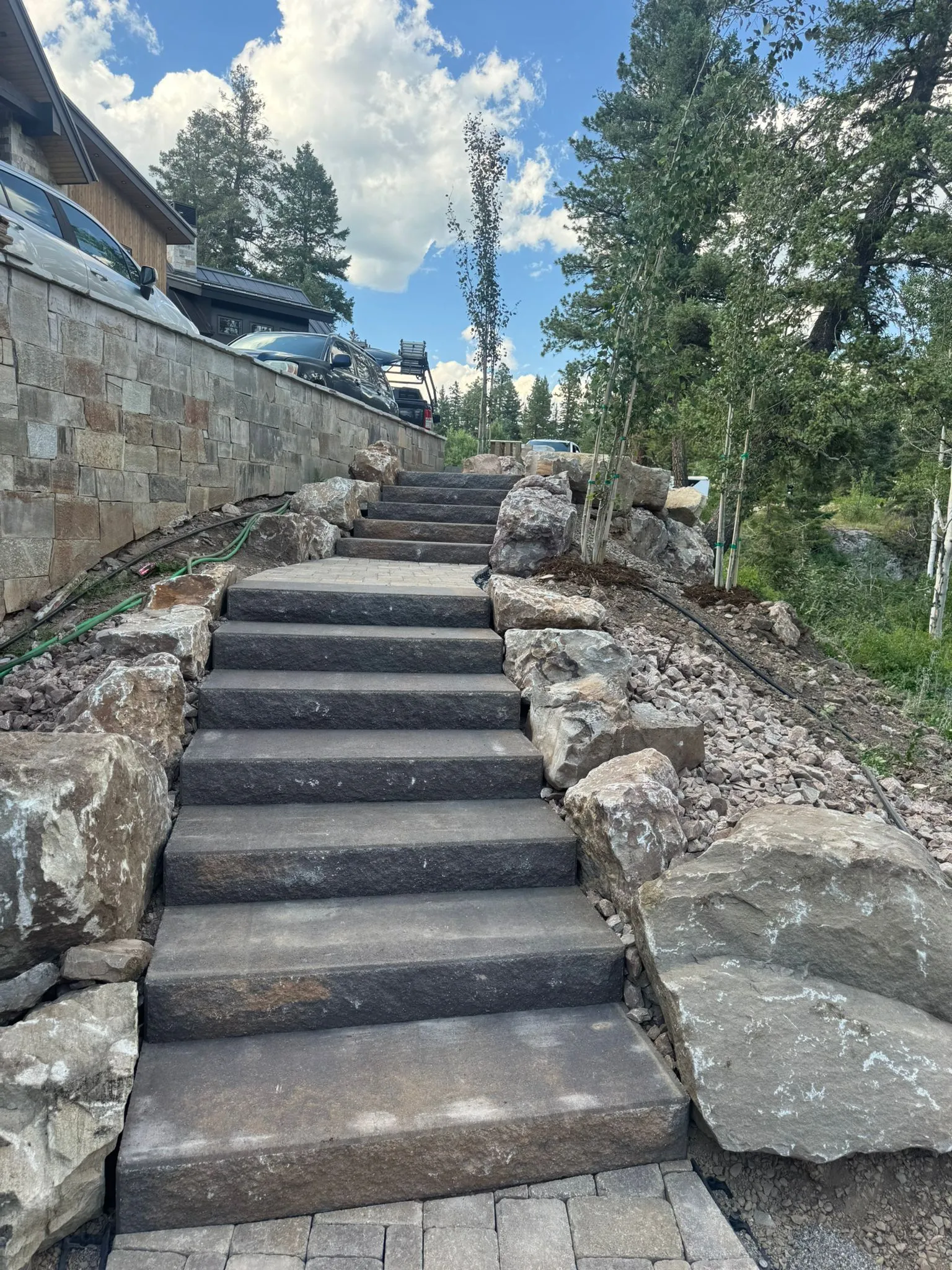
━ Expectations
The most common reason a xeriscape fails is being cut off from irrigation too early. Native planting earns its drought tolerance by growing deep roots, and that takes two to three seasons.
Year One
Run times and frequency reduce deliberately. The planting starts to fill in and the bed begins to read as designed.
Year Two
Run times and frequency reduced deliberately. Planting starts filling in and the bed begins to read as designed rather than dotted.
Established
Most planting on minimal supplemental water. This is when the numbers on your water bill start to change.
Ongoing
Seasonal cutback, weed pressure, mulch topping, and irrigation checks. A few hours per season, not a weekly mow.
━ Boundaries
We handle
We refer out
Most properties have an obvious first candidate: a side-yard strip, a north-facing slope, a berm nobody ever uses. Convert that, see how it looks after a season, and then decide about the rest.